
Leadership That Creates More Leaders
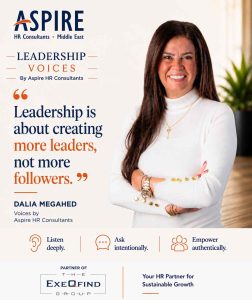 Great leadership is not about creating followers. It is about helping other people become confident, capable leaders themselves.
For Dalia Megahed, that belief has been shaped by years of experience leading people, building teams, and learning that every individual brings a different combination of strengths, motivations, capabilities, and needs.
Her leadership philosophy begins with a simple belief:
Everyone has potential—but not everyone has the same capabilities, motivations, or needs.
Over time, Dalia discovered that effective leadership is less about correcting every weakness and more about understanding what people naturally do well, then creating teams in which different strengths complement one another.
“Early in my career, I spent too much time trying to fix people’s weaknesses—and I’ll be honest enough not to call them ‘development areas.’ I eventually realized that the real magic happens when you understand what people are naturally good at and give them the opportunity to use it.”
That realization changed not only how she developed people, but also how she viewed performance.
A strong performer can have a difficult day. Someone who has struggled in one role may excel when given a different opportunity. Past performance can provide context, but it should not become a permanent label.
For Dalia, every situation deserves a fresh perspective, and every individual deserves to be seen as more than the result of their last assignment.
Listen Before You Lead
One of the most important skills a leader can develop is the ability to listen without immediately forming a conclusion.
Leaders often believe they know what their teams need. Experience, however, has taught Dalia that assumptions can easily become barriers.
“Sometimes we think we know what people need. I’ve learned to ask instead. Some people need guidance, some need space, and sometimes they simply need someone to believe in them.”
Active listening allows leaders to understand what is actually happening rather than responding based on what they expect to be happening.
It also sends an important message: the individual’s perspective matters.
When people feel heard, leaders gain greater insight into the challenges, motivations, and opportunities that may be influencing performance.
Motivation Changes Everything
Talent alone does not guarantee performance.
Dalia has seen exceptionally capable people underperform after losing their motivation. She has also watched others achieve far beyond expectations because they believed in the work they were doing and were motivated to give it their best.
The challenge for leaders is that motivation is deeply personal.
One employee may appreciate public recognition. Another may be motivated by financial reward. Someone else may want a challenging assignment, increased responsibility, exposure to senior leadership, or a clear opportunity for advancement.
There is no single formula.
“As a leader, you need to know what makes each person tick. You cannot assume that what motivates you will motivate everyone else. When you understand what drives people, they feel seen—not simply managed.”
Understanding individual motivation can transform the relationship between a leader and a team member.
Instead of applying the same management approach to everyone, leaders can create an environment in which people have meaningful reasons to contribute, grow, and perform at their best.
Trust, But Don’t Assume
One conversation fundamentally changed Dalia’s understanding of trust.
A member of her team once told her:
“Stop following up with me. Let’s agree on the deadlines and trust my capabilities.”
The comment surprised her.
Dalia had viewed frequent follow-up as a form of support. From the employee’s perspective, however, the same behavior could feel like a lack of trust.
It was an important reminder that leadership intentions and employee experiences are not always the same.
Yet the lesson was more complicated than simply giving people greater independence.
The same individual who wants complete autonomy when working in a familiar area may need significant support when taking on a new responsibility, navigating an unfamiliar environment, or managing a challenging stakeholder.
“That’s why I stopped assuming what support people need. I ask. Sometimes the answer is, ‘Trust me and give me space.’ Other times it’s, ‘I need you to help me through this.’ The same person can need a completely different leader depending on the situation.”
Strong leadership is adaptable. It responds not only to the individual, but also to the circumstances surrounding that individual.
You Don’t Need to Have All the Answers
Earlier in her leadership journey, Dalia believed that being a good leader meant being able to provide solutions.
When a team member encountered a problem, her instinct was to help solve it. The intention was positive, but the unintended consequence could be dependency rather than development.
Over time, she realized something equally important:
Her answer was not necessarily the best answer.
“Sometimes the best answer is sitting with someone on your team. If I’m always the one providing the solution, I’m not only limiting their growth—I’m limiting my own opportunity to learn from them.”
This shift changed the way she approaches leadership conversations.
Instead of immediately offering an answer, she increasingly uses questions. Instead of directing, she coaches. Instead of assuming she has the best solution, she creates space for others to think, contribute, and lead.
That approach helps people build the confidence required to make decisions independently rather than continually looking upward for approval.
Creating Confidence, Not Dependence
Leadership development is not about creating another version of the leader.
It is about helping individuals become the strongest version of themselves.
That distinction matters.
When leaders expect others to think, communicate, or make decisions exactly as they do, they may unintentionally limit the diversity of thought that makes teams stronger.
When leaders instead create room for different approaches and perspectives, they give others permission to develop their own leadership identity.
The goal is not dependence. The goal is capability.
Lead With Your Heart Before Your Title
Ultimately, Dalia measures leadership by more than business performance.
Results matter. Targets matter. Organizational success matters. But so does what happens to the people who helped produce those results.
Her philosophy can be summarized in one sentence:
“Leadership is about creating more leaders, not more followers.”
For Dalia, one of the most meaningful signs of successful leadership is seeing someone who once depended on her become a person that others now depend upon.
Her advice to fellow leaders is simple:
“Lead with your heart before you lead with your title.”
Be genuine. Listen. Don’t label people. Understand what motivates them. Trust them enough to give them space, and care enough to be there when they need you.
Because at the end of a career, people may not remember every target you achieved or every business result you delivered. But they will remember whether you believed in them, whether you helped them believe in themselves, and whether they became more confident and capable because you were part of their journey.
For Dalia, that is the real legacy of leadership.